
Aljibes Medievales Siglo XIV.
Aljibe Fondero – Aljibe Somero
C/ Ramón y Cajal S/N.
44001 Teruel
Phone +34 978 602 810
 Price.
Adults 1,30€.
Grups (Least 20 people) 1,00 €
Kids between 7 and 14 1,00 €
Rejoiced 1,00 €
Entrance free for young children.
 Schedule .
Mornings from 11:00H to 14:00H.
Afternoons de 17:00H to 19:00H.
In Christmas and during the ‘Vaquillas del Angel’ we will be closed too.
 Access adapted for disabled people.
THE MEDIEVAL CISTERN
INTRODUCTION
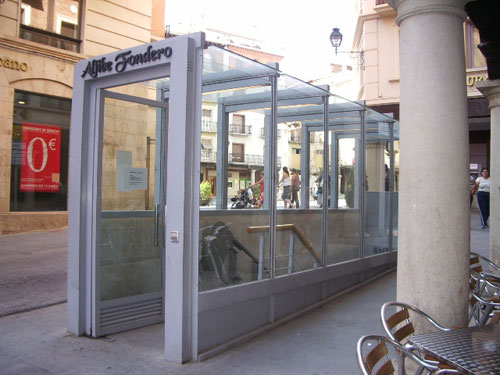
The town of Teruel was founded in 1171 by Alfonso II of Aragón. It is located on top of a terrace near the confluence of the Alfambra and Guadalaviar rivers. The location on a hill favored the defense of the city, but it also made the water supply difficult, since the banks of the Turia River were situated outside the city walls.
If we analyze the location selected for the new city, we observe that its strategic position was important not only from a defensive point of view, but also as a communications junction between the Mediterranean coast and the interior of the Iberian Peninsula. However, the altitude and the lack of groundwater made it impossible for the new town to satisfy the minimum water requirements of an urban settlement. Life inside the city walls during times of siege was especially difficult because the town only had small wells, which were insufficient to provide water for all the inhabitants living within the walls. This constant danger led, in later centuries, to the partial solution of the problem through the construction of cisterns for water storage.
HISTORICAL CONTEXT
King Pedro IV of Aragón granted Teruel the privilege of city status in 1347 as a reward for the loyalty of the people of Teruel to the royal cause during the conflict against the Union of Aragón, which was definitively defeated in the summer of 1348. Teruel’s strategic position between the rebellious areas of Zaragoza and Valencia played an important role in supporting the king.
However, during the War of the Two Peters — fought between Pedro IV of Aragón and Pedro I of Castilla — the city distanced itself from the monarch. In 1363, the troops of Pedro I reached the gates of Teruel. Fearing the destruction of the walls and the city, one of the town judges decided to open the Gate of San Miguel to the Castilian army. The Castilians controlled the city for a short period, and from that moment the gate became known as the “Gate of Treason.” As punishment, the monarch revoked the privileges previously granted to the city for three years, until September 1366, when he finally pardoned the inhabitants and restored their rights.
The privileges granted by the monarch included the following: Teruel became the head of a community, it obtained representation in the legislative assembly, and the life of the city was governed by the legal code known as the Jurisdiction of Teruel, which regulated the economic, political, and military aspects of the community.
For this reason, it was extremely important for the citizens of Teruel to preserve the privileges granted by the king.
One of the most serious problems in Teruel was the water supply, mainly due to the rapid growth of the town. To solve this problem, in 1374 King Pedro IV “the Ceremonious” ordered the construction of three public cisterns whose function was to collect rainwater. These cisterns were strategically built in places that could take advantage of the differences in elevation throughout the city, allowing large quantities of rainwater to be channeled into them.
The chosen location for the construction of the cisterns was the Market Square, today known as Torico Square. This area benefited from the difference in height between the upper parts of the hill — especially the Jewish quarter — and the lower zone surrounding the square, making it possible to channel rainwater from different slopes into the underground cisterns beneath the square.
The supervisor of these works was Brahem Bellito, a member of a family of builders responsible for some of the most emblematic works of Mudéjar architecture in Aragón. In Zaragoza, he participated in the construction of the refectory of the Convent of Santo Domingo and, within the enclosure of the Aljafería Palace, in the Church of Saint Martin and in several halls of Pedro IV’s palace.
Historical documents refer to the construction of three cisterns: two of them, known as Aljibe Fondero and Aljibe Somero, have been identified, while the third has not yet been located through archaeological research. Both preserved cisterns are located beneath the current Plaza Carlos Castel.
THE CONSTRUCTION OF THE CISTERNS
The construction work began in 1373, but shortly afterwards a tragic accident delayed the project far beyond the expected completion date. Twenty-three people died when the weight of the vault collapsed onto the workers inside the cistern. This tragedy, together with the constant military conflicts that affected the region during the late 14th century, significantly delayed the completion of the works.
In 1411, repair and cleaning works were carried out on the water channels of the cistern. Later, it was decided to close the well curb located in the Market Square with hinges and a locking mechanism. There may have been several reasons for this decision: preventing water theft, protecting the water from contamination, or controlling the amount of water extracted daily from the cistern.
After the tensions between Aragón and Castilla ended with the signing of the Peace of Almazán in 1375, the city of Teruel gradually lost part of its geostrategic importance.
WHAT IS A CISTERN AND WHAT IS IT USED FOR?
In Spain, a cistern is commonly called an aljibe, a word of Arabic origin. A cistern is an underground structure covered by a barrel vault or slightly pointed vault, usually built in brick, whose purpose is to store water.
These structures were intended for human consumption and were filled either by collecting rainwater or by transporting water in barrels and carts from rivers, springs, or irrigation channels.
Cisterns were usually constructed with bricks joined by mortar. Their internal walls were coated with a waterproof mixture made of lime, sand, iron oxide, red clay, and resin from the lentisk tree in order to prevent leaks and preserve the quality of the water.
Having a cistern was considered a luxury reserved for wealthy families because their construction was expensive. Most people, except for a few fortunate enough to own good wells, had to store water in jars or vats.
The construction of cisterns responded to the need to store water during periods of scarcity or military siege. Although their traditional use was water storage, during the Spanish Civil War the emergency exits connected to some cisterns were also used as shelters during bombings.
FONDERO AND SOMERO CISTERNS
After crossing the entrance hall, visitors reach the first cistern, known as the Fondero Cistern. It is covered by a pointed barrel vault and is located beneath the central area of Torico Square.
Inside, visitors can observe a wooden bucket that was once used to extract water from the cistern through a well located in the Market Square. Before continuing to the second cistern, visitors may access a lower platform where impressive stalactite formations can be seen decorating the vault and walls.
Between the two cisterns, visitors can observe a model showing the location of the cisterns during medieval times. In the ceiling area, a fragment of the old water channeling system can also be seen: a brick tunnel that formed part of the hydraulic works designed by Pierres Vedel during the 16th century.
This project consisted of the construction of the aqueduct-viaduct known as “Los Arcos,” which brought water from the spring called Peña del Macho to the city through a rolling-water system, distributing it among the different public fountains of Teruel.Along the gallery, visitors can enjoy a photography exhibition related to water, organized by the Asociación Fotográfica Turolense, where different natural landscapes of the province are displayed.The Somero Cistern, recently restored, preserves its medieval ceramic floor and the reddish mortar coating on its walls.
Today, it also serves as a tourist reception area where visitors can watch audiovisual presentations about Teruel.